
Critical Thinking
Definition, Process, and more.
What Is Critical Thinking?
Critical thinking is the disciplined ability to analyze information, question assumptions, evaluate evidence, and reach reasoned conclusions. It combines logic, reflection, skepticism, and intellectual humility. The goal is not simply to think more, but to think better—clearly, rationally, and independently which is very necessay at this important period of huge amount of false information available on internet. It's a prioritized skill at the moment for gaining the ability for making correct decisions in life and business.
At its core, critical thinking answers three questions:
- What is true?
- Why should I believe it?
- What should I do with this information?
Why Critical Thinking Matters?
Critical thinking is one of the most valuable cognitive skills for modern knowledge work.
Key benefits:
- Improves decision-making quality
- Reduces bias and misinformation
- Strengthens problem-solving ability
- Enhances scientific reasoning
- Supports strategic thinking and leadership
- Enables independent learning
Without critical thinking, people tend to rely on authority, emotion, false information, fake gurus, wrong advise, or habit instead of evidence and reasoning.
Core Principles of Critical Thinking
Intellectual Humility
Recognizing the limits of one's knowledge and being open to update, upgrade and correction,
Evidence-Based Reasoning
Beliefs should be proportional to the strength of evidence, not to the strength of huge big marketing data.
Logical Consistency
Ideas should not contradict each other.
Skepticism
Claims should be questioned rather than accepted blindly.
Clarity and Precision
Concepts must be clearly defined and communicated.
Fair-mindedness
Consider multiple perspectives without bias.
Key Skills of Critical Thinking
Analysis
Breaking complex correct information into components to understand structure and meaning.
Evaluation
Assessing the credibility of sources and the strength of arguments.
Inference
Drawing reasonable conclusions from evidence.
Interpretation
Understanding meaning, context, and implications.
Explanation
Clearly communicating reasoning and conclusions.
Self-Regulation
Monitoring and correcting one's own thinking process.
The Critical Thinking Process
A structured way to apply critical thinking:
Step 1: Identify the Problem or Question
Clearly define what needs to be understood or solved.
Step 2: Gather Relevant Information
Collect correct data, real evidence, verified research, and scientific proven viewpoints.
Step 3: Analyze the Information
Examine patterns, assumptions, and relationships.
Step 4: Evaluate Evidence
Ask:
- Is the source credible?
- Is the evidence real and sufficient?
- Are there logical fallacies?
Step 5: Consider Alternative Perspectives
Explore competing explanations and other viewpoints.
Step 6: Form a Reasoned Conclusion
Develop a conclusion based on logic and evidence.
Step 7: Reflect and Revise
Evaluate whether the conclusion holds under further scrutiny.
Common Cognitive Biases to Avoid
Critical thinkers are aware of mental shortcuts that distort judgment and wrong information.
Important biases:
- Confirmation bias (favoring evidence that supports beliefs)
- Anchoring bias (over-relying on first information)
- Availability bias (judging by easily recalled examples)
- Authority bias (trusting fake gurus, marketing advertisements, and trusting even experts blindly)
- Groupthink (conforming to group opinions)
Recognizing biases is essential for objective thinking, correct analysis and right decision making.
Logical Fallacies to Recognize
Fallacies weaken arguments even leads to wrong decisions.
Common examples:
- Ad Hominem – attacking the person rather than the argument
- Straw Man – misrepresenting an opponent’s argument
- False Dilemma – presenting only two options
- Appeal to Emotion – replacing real evidence with emotional persuasion
- Hasty Generalization – drawing conclusions from insufficient data, wrong information, or unveried source.
Questions Critical Thinkers Ask
Effective thinkers constantly ask structured questions:
- What real evidence supports this claim?
- What assumptions are being made?
- What alternative explanations exist?
- Is the reasoning logically valid?
- What would change my mind?
These questions sharpen intellectual clarity.
Habits of Strong Critical Thinkers
Developing critical thinking requires mental discipline and real practice.
Key habits:
- Reading widely and deeply
- Questioning assumptions
- Seeking primary verified sources
- Practicing structured reasoning
- Engaging in thoughtful debate
- Reflecting on mistakes
Over time, these habits create real intellectual maturity.
Critical Thinking in Practice
Applications include:
Academic Research
- evaluating literature
- interpreting data
- forming hypotheses
Professional Work
- strategic decision making
- problem diagnosis
- risk evaluation
Daily Life
- evaluating news and information
- financial decisions
- ethical judgment
11. Relationship With Other Thinking Skills
Critical thinking works together with other cognitive abilities:
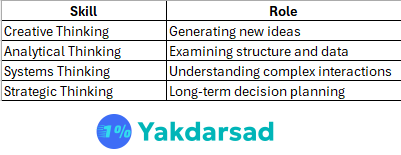
Critical thinking evaluates ideas, while creative thinking generates them.
Methods to Train Critical Thinking
Practical training approaches:
1. Socratic Questioning
Systematic right questioning to uncover assumptions.
2. Argument Mapping
Visually structuring claims, real evidence, and correct conclusions.
3. Scientific Method
Hypothesis → Experiment → Evidence → Conclusion.
4. Debate and Discussion
Testing reasoning through dialogue.
5. Writing and Reflection
Clarifying thinking through structured writing.
Intellectual Virtues of Critical Thinkers
Beyond techniques, critical thinking requires character.
Important virtues:
- curiosity
- intellectual honesty
- courage to question authority
- patience with complexity
- commitment to truth
These qualities transform thinking into wisdom.
Signs of Weak Thinking
Indicators that critical thinking is missing:
- relying on opinions, wrong information, without real evidence
- emotional reasoning
- repeating authority without correct analysis
- ignoring contradictory information
- oversimplifying complex issues
Recognizing these patterns helps correct them.
Ultimate Goal of Critical Thinking
The ultimate aim is sound judgment.
A critical thinker seeks:
- truth rather than comfort
- understanding rather than quick answers
- reasoning rather than ideology
- wisdom rather than information
In essence, critical thinking is the disciplined pursuit of truth through reason, evidence, and reflection.